
an English tutor
Reading & Writing
Building Vocabulary Without Memorising Word Lists
A strong vocabulary can transform the way you read, write and communicate. It can help you express ideas more precisely, understand challenging texts and write with greater confidence.
But - building vocabulary doesn't mean memorising endless lists of complicated words.
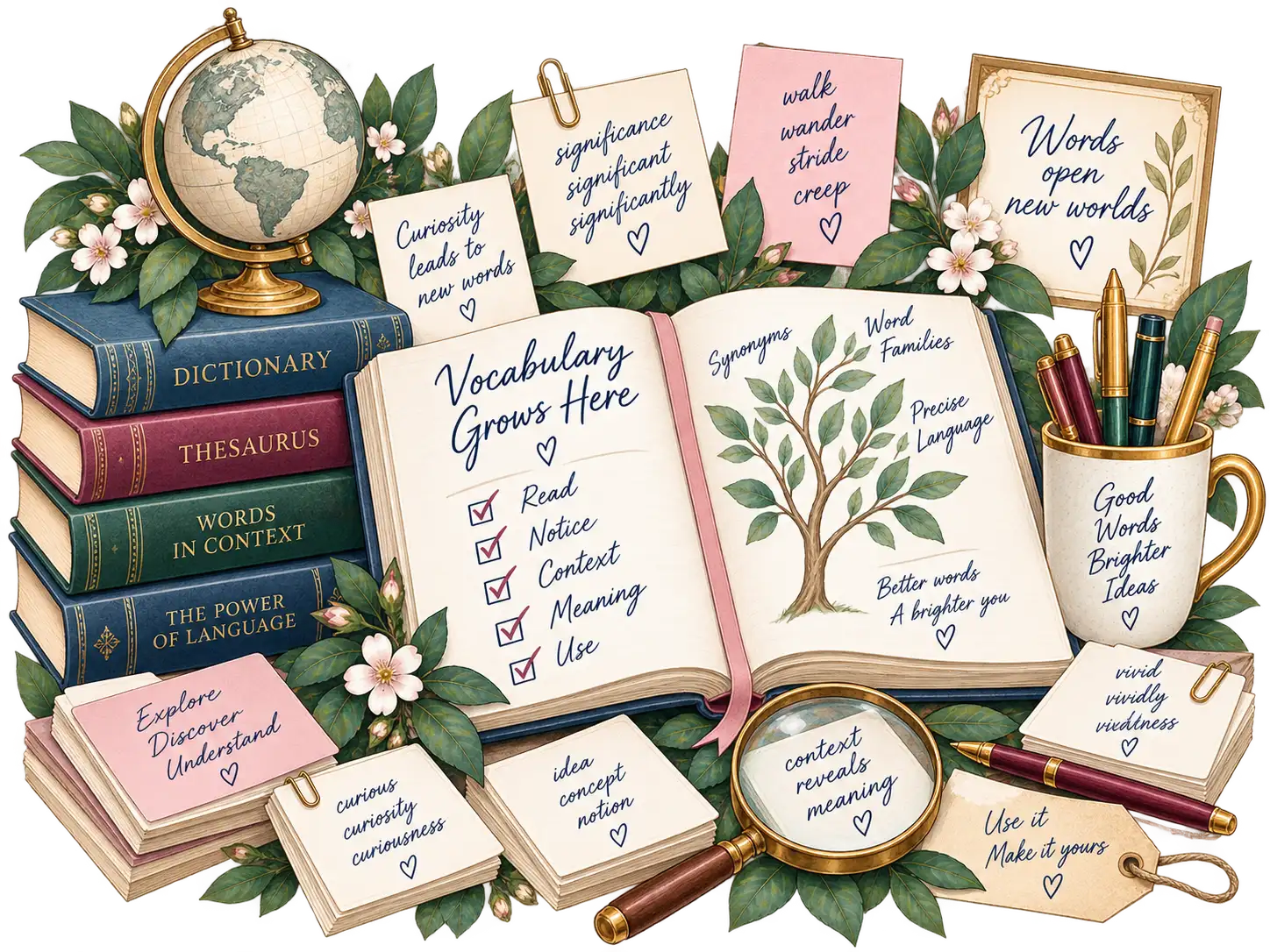
In fact, learning words in isolation often makes them difficult to remember and even harder to use naturally. A better approach is to encounter words in context, explore how they work and then actively use them yourself.
1. Read – and notice
Reading is one of the most effective ways to develop vocabulary because you encounter words being used naturally.
When you come across an unfamiliar word, don't automatically skip it. First, look at the surrounding sentence and see whether you can work out its meaning from the context.
For example: The once bustling street was now desolate; shops stood empty and not a single person could be seen.
Even if you haven't encountered desolate before, the rest of the sentence gives you clues about its meaning.
This is an important reading skill in itself: strong readers don't always know every word – they become good at working out what unfamiliar words are likely to mean.
2. Learn words in context
A definition alone doesn't necessarily teach you how to use a word.
Instead of recording: melancholy = sad
try: melancholy – a thoughtful, lingering sadness
There was something melancholy about the abandoned playground.
Now you have the meaning, but you also have a sense of the word's tone, associations and use in a sentence.
That makes it much easier to remember and much less likely that you'll use it incorrectly.
3. Build word families
One new word can sometimes give you several.
Take significance:
- significance – noun
- significant – adjective
- significantly – adverb
- signify – verb
Learning related words helps you understand how vocabulary can be adapted for different sentences and purposes.
It also develops your understanding of word classes, which can be particularly useful when analysing a writer's language.
4. Explore shades of meaning
Synonyms rarely mean exactly the same thing.
Consider: walk - wander - stride - stagger - creep
Each describes movement, but each creates a very different impression.
A character who strides into a room might appear confident or purposeful. Someone who creeps into the same room creates an entirely different impression.
Instead of simply collecting synonyms, ask: what is the difference between these words? This is how vocabulary becomes more precise.
5. Collect vocabulary by idea
Rather than memorising random lists, group useful vocabulary around concepts you regularly encounter.
For example, when studying character you might collect:
- Power: authoritative, dominant, commanding, oppressive
- Fear: apprehensive, uneasy, vulnerable, terrified
- Conflict: hostile, confrontational, divided, antagonistic
This can be particularly useful in English Literature because it gives you a bank of precise vocabulary for discussing characters, relationships and themes.
The important thing, however, is to understand each word rather than simply memorise it.
6. Pay attention to vocabulary in everyday life
New vocabulary doesn't only come from novels. You encounter language in articles, documentaries, podcasts, conversations, advertisements, films and even social media. If you notice an interesting word, phrase or expression, stop and think about why it caught your attention.
- What does it mean?
- Why was that particular word chosen?
- Could you use it yourself?
Becoming curious about language is one of the best ways to develop your vocabulary naturally.
7. Use new words
Recognising a word and being able to use it confidently are two different things.
Try using new vocabulary in your own sentences. You might deliberately include a new word in a piece of creative writing, use it when discussing a literary character or challenge yourself to use it in conversation.
The more often you retrieve and use a word, the more likely it is to become part of your active vocabulary.
8. Don't choose a complicated word when a precise one is better
Students sometimes assume that ambitious vocabulary means using the longest or most unusual word they can find.
It doesn't.
Compare: The writer uses nice imagery to show the setting.
with: The writer uses vivid imagery to emphasise the beauty of the setting.
Vivid isn't particularly complicated. It is simply more precise. Strong writers choose words because they communicate exactly what they mean – not because they sound impressive.
9. Revisit vocabulary
You are unlikely to remember a word after encountering it once.
Return to useful vocabulary regularly. Cover the definition and see whether you can remember it. Write a new sentence using the word. Think of a synonym or antonym. Explain the word to somebody else.
Each time you retrieve the meaning, you strengthen your memory of it.
Build curiosity, not just a word bank
Ultimately, developing a strong vocabulary is less about how many words you can memorise and more about becoming curious about language.
Notice unfamiliar words. Explore their meanings. Think about their associations. Compare them with similar words. Most importantly, use them.
Over time, those words become part of your own vocabulary, giving you greater precision and confidence when reading, analysing, speaking and writing.

Need personal support ?
Every student learns differently. If you would like tailored
one-to-one guidance, discover how personalised tuition
can help build confidence and achieve lasting success.
Explore Private Tuition